



Duterte’s ICC case: What happens next?
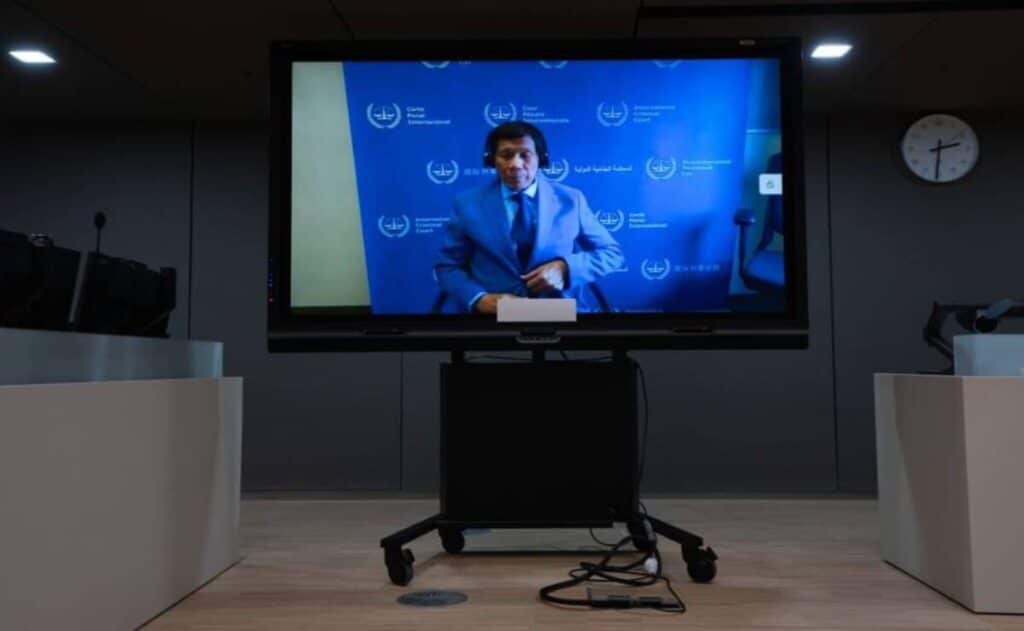
MANILA, Philippines — Five months after painstakingly being deferred by his lawyers, the pre-trial proceedings of former President Rodrigo Duterte for his three counts of crime against humanity of murder will proceed before the International Criminal Court (ICC) in The Hague.
The court found Duterte fit to take part in them and he will face for the second time the judges of the ICC Pre-Trial Chamber I (PTC I).
The chamber set the hearing of the confirmation of his charges, as well as the annual hearing on the review of his detention for four days on February 23, 24, 26 and 27.
It remains unclear whether Duterte’s participation in the hearings will be physical or virtual. But he is expected to physically attend the hearings, pending an approval of
the defense’s request for video conferencing.
READ: ICC prosecution disputes 2 Duterte pleas
The ICC Office of the Prosecutor (OTP) alleged Duterte had committed the following three counts of crimes against humanity for murders during his “war on drugs” campaign from Nov. 1, 2011 to March 16, 2019.
Specifically, these were the killings perpetrated by the so-called “Davao Death Squad” during his time as Davao City mayor; murders of “high-value” targets when he was the Philippine President, and the murders and attempted murders during barangay clearance operations across the country during his presidency.
‘Indirect co-perpetrator’
The OTP alleged that Duterte committed these crimes as an indirect co-perpetrator through the creation of a common plan with at least eight other co-perpetrators, including Senators Ronald “Bato” dela Rosa and Bong Go, to neutralize the alleged criminals who were perceived to be involved in illegal drugs.
The hearings will take place before the three judges of ICC PTC I, composed of Presiding Judge Iulia Motoc (Presiding Judge), Judge Reine Adélaïde Sophie Alapini-Gansou and Judge María del Socorro Flores Liera.
READ: ICC: Duterte fit to stand trial, 500 victims cleared to join in case
The OTP led by Deputy Prosecutor Mame Mandiaye Niang; counsel for Duterte headed by Nicholas Kaufman; and legal representatives of the victims composed of Filipino lawyers Joel Butuyan and Gilbert Andres shall present their evidence and views.
Sufficiency of evidence
According to the ICC, the confirmation of charges hearing is to determine whether there is “sufficient evidence” to establish “substantial grounds to believe” that Duterte committed each of the crimes charged against him.
READ: ICC: Prosecution in Duterte ICC trial has until July 1 to submit evidence
Within 60 calendar days after the end of the confirmation of charges hearing, or by April 28, the ICC judges will make a decision on whether or not to confirm all or any of the charges brought against Duterte by the OTP.
There are three possible outcomes that may happen, according to separate briefers from the ICC and the Institute of International Legal Studies of the University of the Philippines – College of Law:
Scenario 1:
If there is sufficient evidence to confirm the charges, Duterte will need to remain in detention to face a full trial that may lead to his conviction or acquittal.
A Trial Chamber will then be constituted, which is composed of three judges other than those who sat on the ICC PTC I bench.
READ: Duterte drug war: ICC named Dela Rosa, Bong Go co-perpetrators
According to Cristina Conti, an ICC-accredited assistant to counsel, ICC trials may take an average of eight years to complete, depending on the complexity of the cases, with a number even going for 10 years. This excludes several months for the Trial Chamber to arrive at its judgment and sentencing, and another one to two years for the appeals.
Scenario 2:
If there is insufficient evidence to support the charges, the PTC I will stop the proceedings against Duterte.
The judges shall then give orders on the next steps, including the possible release of Duterte from his detention as the warrant of arrest lapses.
However, this does not preclude the OTP from appealing or asking for confirmation again upon submission of additional evidence later on.
Scenario 3:
The ICC PTC I will adjourn the hearing and request the OTP to provide further evidence, to conduct further investigations or to amend any charge for which the evidence submitted appears to establish commission of a crime other than the one charged.
The warrants of arrest in relation to the charges not confirmed by the judges also cease, which may lead to Duterte’s release from detention.
Not entitled to appeal?
According to the ICC, the defense and prosecution do not have the entitlement to automatically appeal whatever the decision of the judges may arrive at. But they can request authorization from the PTC to do so.
The chamber will conduct the hearings February 23 to 24, and February 26 to 27, starting at 5 p.m. (Philippine time). Each day will have three sessions lasting for five hours, including two-hour breaks.
On the last day on Feb. 27, the PTC I also dedicated an hour for the hearing of the review of the continued incarceration of Duterte at the ICC Detention Centre in Scheveningen.
Pending Duterte’s trial, the judges must assess whether changed or new circumstances exist that would warrant the release of Duterte, with or without conditions.
The PTC I may order for his continued detention as it had done so in its Jan. 26 decision, where it found no changed or new circumstances to modify its Sept. 26, 2025 ruling rejecting the defense’s request for interim release, and which was later on affirmed by the ICC Appeals Chamber.
According to the ICC, the schedule is subject to change if warranted by developments in the proceedings, as deemed necessary by the chamber.
It added that “for the sake of efficiency,” if a party or participant does not fully utilize the time allotted to it in the schedule, the next presentation shall commence, even if the chamber slates that presentation for the following session or day.
Arrested last year
On March 11, 2025, Philippine authorities arrested Duterte through an arrest warrant issued by the ICC and coursed through the Interpol. Custodians took him to the ICC detention facility the next day and have held him there since.
Duterte’s initial appearance before the ICC took place on March 14, 2025. But on Sept. 8, 2025, the PTC I postponed the confirmation hearing, initially scheduled to start on Sept. 23 the same year, to hear the defense’s request for an indefinite adjournment of the proceedings over Duterte’s alleged cognitive impairment.
Four months later on Jan. 26, 2026, the PTC I found Duterte fit to participate in the pretrial proceedings, citing the medical assessment of three independent medical experts.
Disclaimer: The comments uploaded on this site do not necessarily represent or reflect the views of management and owner of Cebudailynews. We reserve the right to exclude comments that we deem to be inconsistent with our editorial standards.
